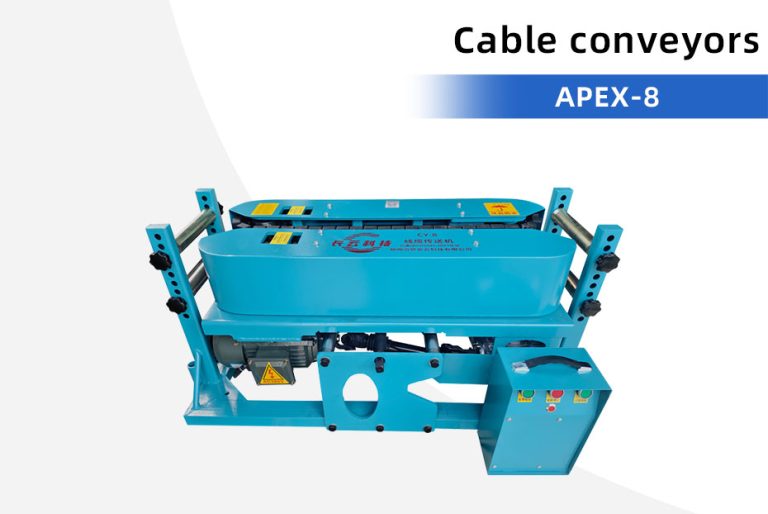

Product Overview
The Cable Conveyor is driven by electric motors, which transmit power to a set of rubber crawler tracks via a reduction gear mechanism. By adjusting the gap between the left and right tracks, the clamping force applied to the cable can be precisely controlled, thereby propelling the cable forward at a constant speed and ensuring a smooth, damage-free installation process.
Working Principle
Driven by an electric motor, the cable conveyor transmits power to the rubber tracks or rollers through a reduction gearbox. The upper and lower tracks clamp the cable with adjustable pressure to generate stable friction, which pushes the cable forward at a constant speed. For long-distance laying, multiple units can work synchronously to provide uniform thrust, ensuring smooth and damage-free cable installation.
Technical Parameter
| Power | 1500W × 2 (Dual pure copper motors) |
| Conveying Speed | 19.2 m/min |
| Max Tension | 6000N |
| Cable Diameter Range | 2–24 cm |
| Dimensions (L×W×H) | 115.4 × 58 × 53 cm |
| Note | Product images are for reference only; actual product may vary.* |
| Net Weight | 243 kg |
Application Areas
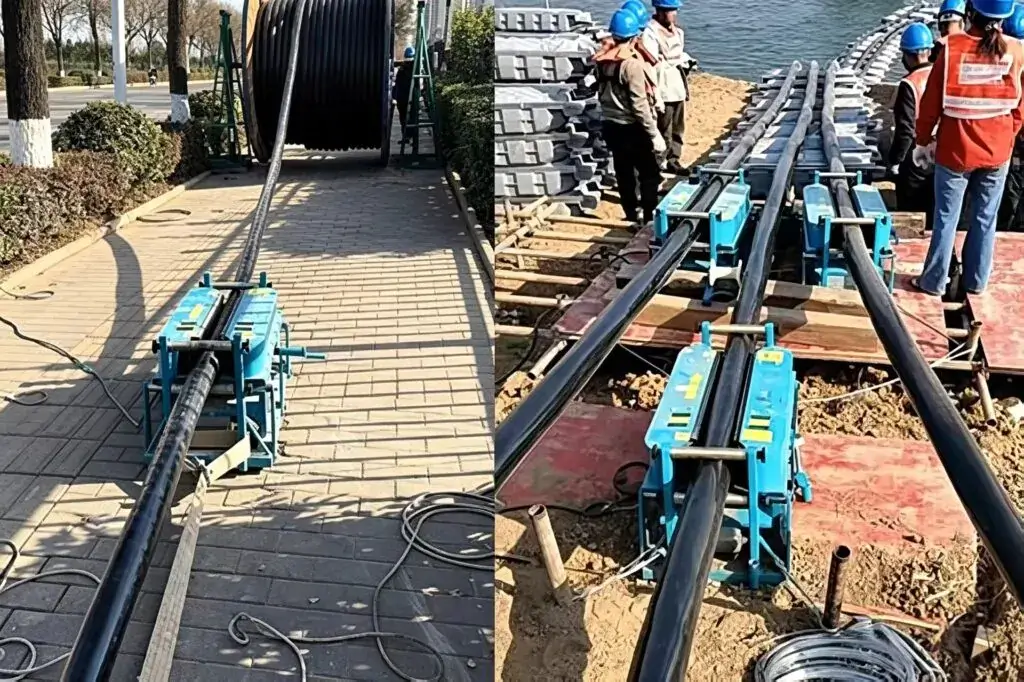
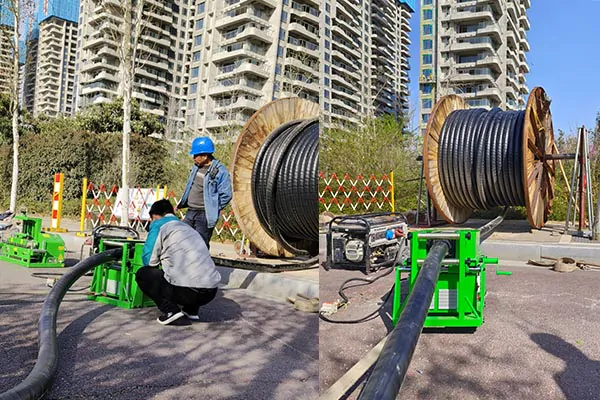
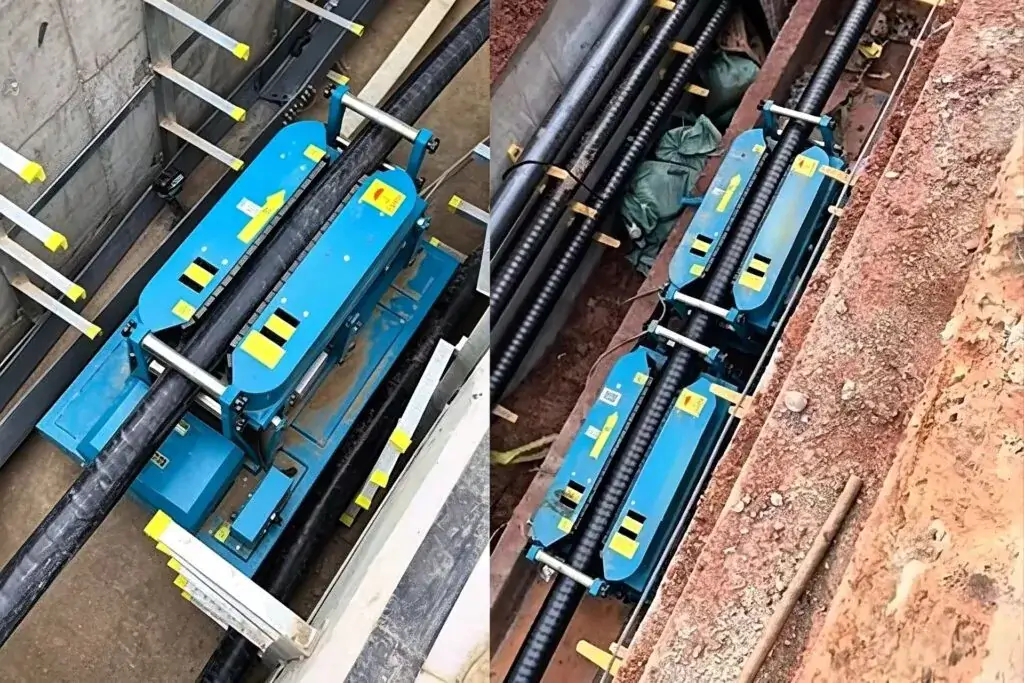
Power Engineering: Cable laying projects in underground pipelines, integrated utility tunnels, cable trenches, or tunnels.
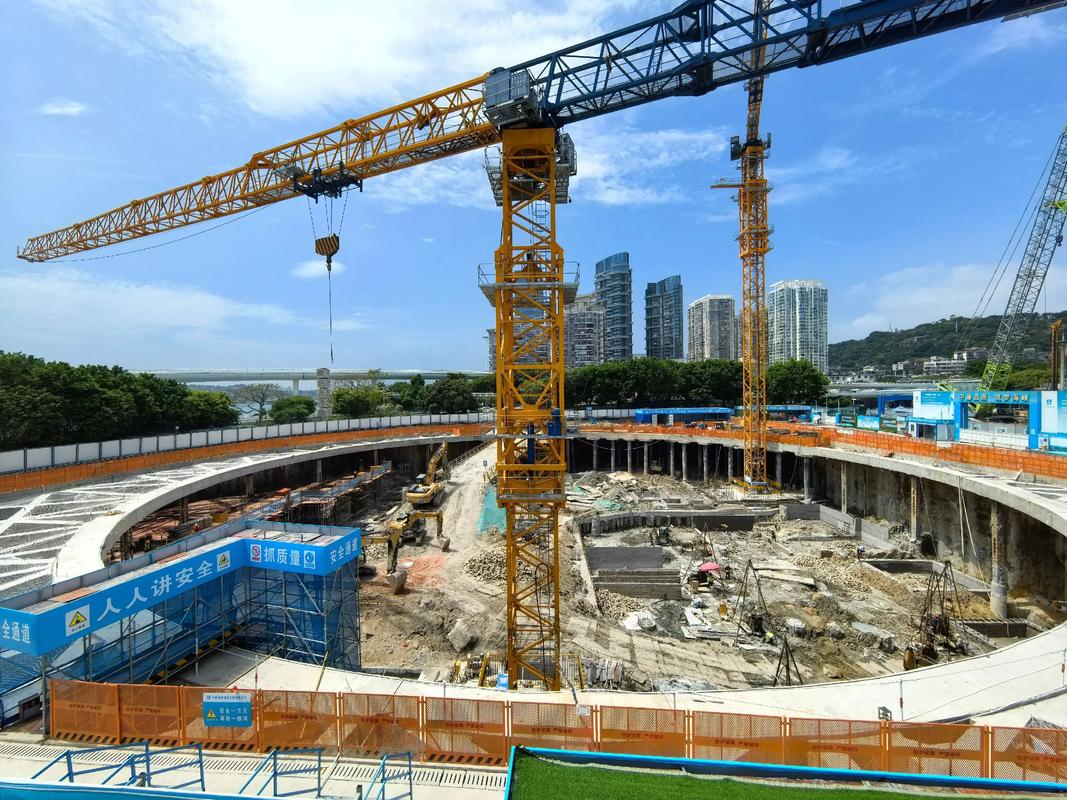
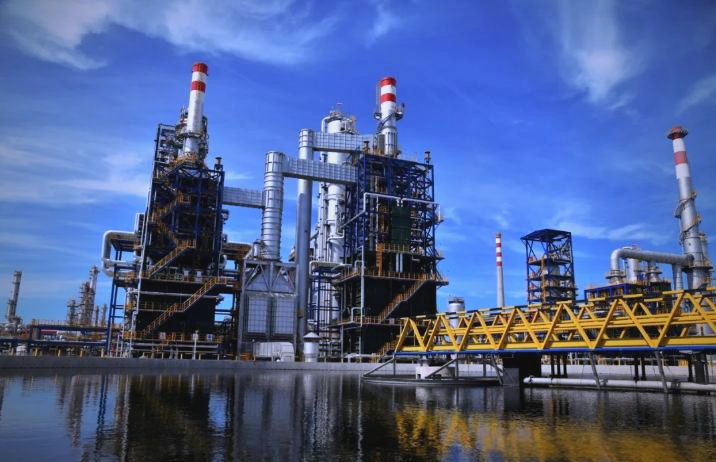
Transportation and Energy Infrastructure: Suitable for high-speed rail stations, rail transit systems, new energy power plants, and large oil refinery projects; cable laying for new projects and cable renovation for existing projects.
Large Infrastructure Projects: Laying main power cables for nuclear power plants, hydropower stations, and high-rise buildings.
Long-Distance Power Transmission: Suitable for on-site direct burial cable laying and overhead cable tray installation in long-distance power transmission projects.
Power Construction: Cable conveying, fiber optic cable conveying, and wire/cable conveying.
Core Features & Advantages
Dual-motor drive, high efficiency and labor saving: The thrust of a single machine is equivalent to the pulling force of 10 workers. Multiple machines working together can shorten the construction cycle by 65%.
Cable protection, safe and reliable: Equipped with flexible tracks or rubber rollers to prevent scratching or twisting of cables, and built-in overload protection effectively reduces construction risks. Ensures high-quality laying.
Stable and controllable: The conveying speed can be steplessly adjusted within the range of 4–26 m/min, achieving smooth start and stop.
Flexible and portable: Compact size and light weight, easy to transport in narrow tunnels and manholes.
Product Features
Core Features
High tension (6000N) & smooth operation
Dual-motor design for stable performance and low noise
Premium wear-resistant rubber blocks–Thickened, anti-slip, and durable
Shaft drive system–Impact-resistant, vibration-proof, and high transmission efficiency
Simplified controls with push-button operation
- FAQ
- Q1: Are the traction ratings for your winches inflated? Can they really pull effectively in challenging terrain (such as mountains or muddy conditions)?
- Customer concern: Worries about falsified specifications and the equipment failing under harsh conditions.
- ✅ APEX’s response:
- “Absolutely genuine, and exceeding standards. The rated pulling force figures for APEX winches are not derived from ideal laboratory conditions, but from actual field tests conducted in extreme environments such as the mountainous regions of south-west China and the Gobi Desert in the north-west. To tackle complex terrain, we have independently developed a high-torque adaptive drive system. Following hundreds of on-site refinements, this ensures that power output does not diminish or slip when climbing slopes or encountering increased resistance in muddy conditions. We dare to promise: whatever tonnage is stated on the nameplate, that is exactly what it will pull in real-world conditions—and potentially even more.”
- Q2: Is this equipment assembled or independently developed? What are the key differences compared to other brands on the market?
- Customer pain points: Concerns about purchasing “OEM products”, technological homogenisation, and a lack of after-sales support.
- ✅ APEX’s response:
- “APEX adheres to 100% in-house R&D and rejects simple component assembly. The key distinction from similar products on the market lies in the fact that our core transmission structure and braking system have been iteratively developed based on extensive feedback from frontline construction sites. For example, to address the issues of excessive heat generation and rapid clutch wear common in traditional winches, we have pioneered a [specific technical name, e.g. dual-stage cooling/wear-resistant clutch] structure. This is not merely an upgrade to the equipment, but a technological barrier forged through tens of thousands of hours of practical experience on construction sites, enabling us to better understand the actual demands of the Chinese construction environment.”
- Q3: Is it safe to operate? If there is a sudden power cut or the engine stalls, will the heavy load fall out of control?
- Customer pain point: Zero tolerance for safety incidents; concern regarding emergency braking performance.
- ✅ APEX’s response:
- “Safety is our bottom line. The entire APEX range comes standard with an industrial-grade, normally closed intelligent braking system, which is the result of significant improvements following the analysis of numerous accident cases. In the event of a power cut, engine stalling or operator error, the brake will automatically lock the drum within 0.1 seconds, ensuring ‘fail-safe’ operation. Furthermore, we have added an overload protection warning function to nip potential safety hazards in the bud, allowing you to work at height or with heavy loads without any concerns.”
- Q4: How durable is the equipment? Is maintenance a hassle? Is it prone to breakdowns in harsh site conditions?
- Customer concern: Worried that high failure rates will affect project timelines, and that repairs are difficult.
- ✅ APEX’s response:
- “Designed specifically for ‘rough-and-tumble’ construction site environments. Through preliminary on-site research, we found that traditional equipment suffers from poor sealing and is prone to sand and dust ingress. Therefore, APEX employs military-grade dust-proof sealing and a reinforced alloy steel chassis, extending the service life of key components by over 50%. Regarding maintenance, we have adopted a modular quick-release design, allowing for routine maintenance and the replacement of wear parts without the need for specialised tools. Even in remote locations without electricity or support, repairs can be carried out swiftly, minimising downtime.”
- Q5: Can you provide tailored construction solutions, or do you simply sell machines?
- Customer pain point: Requires a comprehensive solution, not just individual equipment.
- ✅ APEX’s Response:
- “We don’t just sell machines; we provide towing solutions based on real-world experience. Drawing on our extensive database of site practices, we can tailor the optimal equipment selection and rope winding schemes to your specific operating conditions (such as line length, terrain variations and load types), and even provide on-site operational training. Choosing APEX means choosing a team of experts who understand the technology, know the field and can solve problems.”